Is it a Dragon?
The Danger of Being Locked in a Position

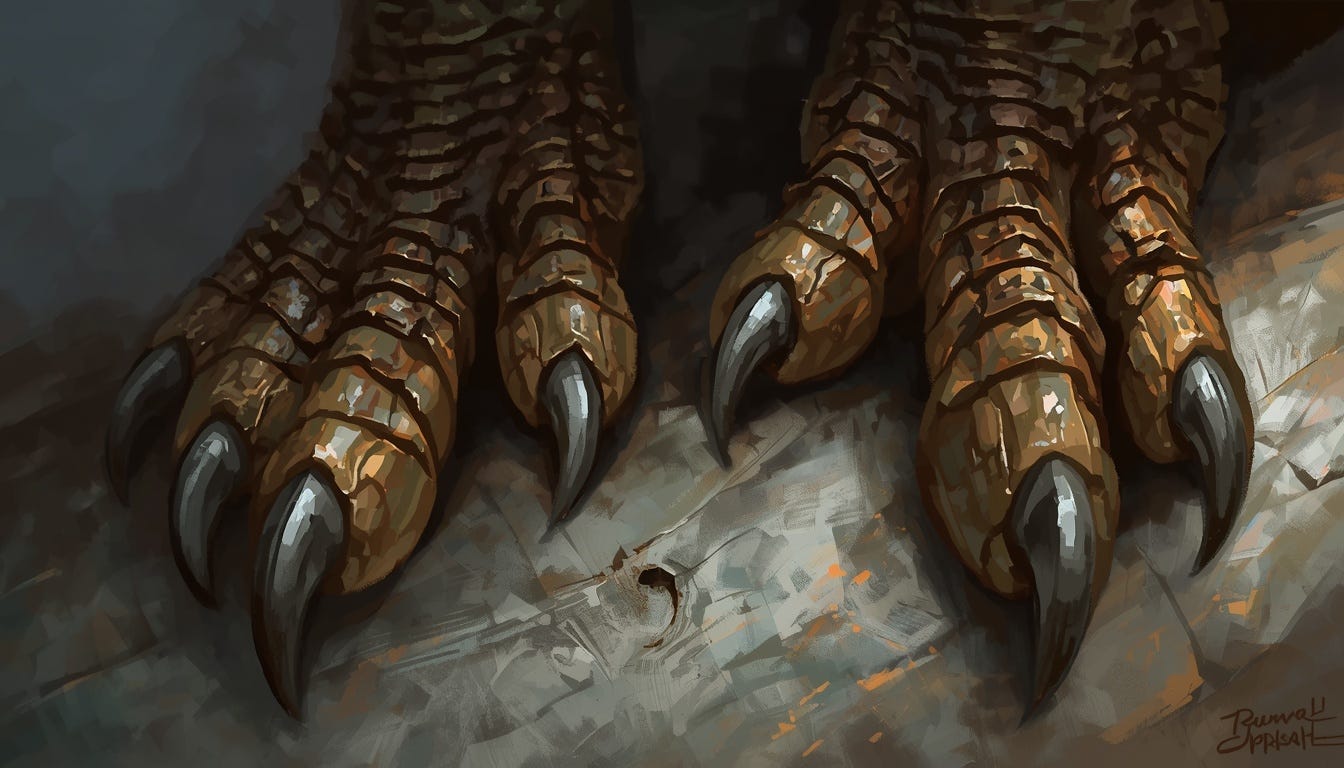
(From my story published on Medium)
According to the late artist Alex Chin, a true depiction of a dragon must have four clawed toes. Otherwise,
“It is not a dragon!”
Chinese and Japanese depictions of dragons often have different numbers of clawed toes. Some writings suggest that, depending upon a person’s status in society, displaying a flag or plaque with a dragon possessing four or five toes indicated a higher rank than one displaying a dragon with only three.
Alex Chin loved this discussion. He took pride in explaining the history and symbolism behind dragons and delighted in teaching others how to accurately draw or paint them.
Of course, in literature, dragon slayers never stop to count toes before confronting a dragon. They would be immediately consumed or burned by the fire breathing monster.
This observation points to a larger truth.
Being positional is limiting. It closes doors to other possibilities. It blocks new information from entering. It narrows vision until all we can see is our own certainty.
History is filled with examples.
For centuries, people believed the Earth was the center of the universe. The idea seemed obvious. The sun rose and set around us. The stars moved across the sky above us. What could be more self-evident?
Then came Nicolaus Copernicus, who challenged conventional wisdom by proposing that the Earth revolved around the sun. His ideas were ridiculed, condemned, and viewed by some as heresy.
Yet truth did not change because people resisted it.
The world changed because someone remained open to seeing it differently.
Throughout history, nearly every breakthrough has begun as an unpopular idea. The abolition of slavery, women’s suffrage, civil rights, modern medicine, and countless scientific discoveries all required people willing to question accepted assumptions and endure criticism in pursuit of a larger truth.
Progress rarely arrives by permission.
It usually arrives through curiosity.
Today, many individuals remain deeply dug in. They see the world through a single lens and refuse to consider alternatives. Discussions quickly become arguments, differences become threats, and certainty replaces inquiry.
“But isn’t it important to stand for something?”
Absolutely.
Having principles, integrity, and character matters. Yet there is a profound difference between being committed and being rigid.
A tree with no roots is easily blown over. A tree that cannot bend snaps during the storm.
Wisdom requires both roots and flexibility.
During my martial arts studies, I encountered a metaphor that has stayed with me throughout life.
Cat Stance.
One leg is firmly planted while the other remains free to move. The grounded leg provides stability and balance, while the mobile leg allows adaptation and response. If both feet are cemented in place, movement becomes difficult, reaction time slows, and opportunities are missed.
The cat stance is not merely a fighting position. It is a philosophy for a way of being.
Learning it reminded me to hold firmly to my core values while remaining flexible about everything else. It is good to know what we believe and, at the same time, stay curious about what we do not yet know.
There is a difference between being “dug in” and being committed. Knowing this difference may be one of the most important skills for surviving the 21st century.
Change is happening at an exponential rate.
Artificial intelligence is accelerating discovery, invention, communication, medicine, transportation, and education. Entire industries are being reshaped before our eyes. New opportunities appear almost daily while old assumptions quietly disappear.
The people who thrive will not necessarily be the strongest or even the smartest. More often, they will be the individuals most capable of adapting to change while continuing to learn.
Naturalist Charles Darwin is often paraphrased as saying that survival belongs not to the strongest species, but to those most responsive to change.
Whether or not those exact words were his, the principle remains true.
Continuous learning is no longer just a great concept. It has become essential to survive.
One of the most dangerous phrases in any organization, family, or society is: “That’s how we have always done it.”
Those words have delayed innovation, prevented growth, and protected countless bad ideas from necessary examination.
At the same time, not everything changes.
An apple remains an apple. Gravity still exists. Kindness still matters. Truth matters. Trust matters.
The challenge is learning to distinguish between timeless principles and temporary assumptions.
In a rapidly changing world, wisdom is not knowing everything. Wisdom is knowing what deserves your commitment and what deserves your attention.
Over the years, I have developed a few personal practices that help me navigate uncertainty. I try to remain aware and alert to what is happening around me, a practice many people describe as mindfulness. I deliberately spend time with thoughtful and open minded people whose presence brings calm rather than conflict. I apply the same standards to the news and educational media I consume, avoiding those whose business model depends upon outrage, anger, or division. I regularly return to authors, philosophers, and thinkers whose ideas have endured across generations, believing there is wisdom in voices that continue to speak across centuries. At the same time, I pay attention to new ideas, inventions, books, films, and experiences that spark curiosity, make me smile, or cause my heart to flutter with excitement. Those moments tell me that I am learning and growing.
When circumstances become especially difficult, I remember one of my favorite scenes from the movie adaptation of
Stephen King’s The Shawshank Redemption.
Andy Dufresne escapes prison by crawling through a pipe filled with human waste that stretches the length of two football fields.
Whenever I face a frustrating obstacle, a difficult life challenge, or a bewildering new technology, I remember Andy crawling forward through the muck and darkness toward possibility.
Progress is often uncomfortable. Sometimes it is messy. Occasionally, it stinks. But the alternative is remaining trapped.
So perhaps a dragon has three toes. Perhaps it has four. Perhaps it has five. It may have two legs or four. It may look different depending upon who draws it, where they live, or what traditions they inherited.
If a dragon is approaching, however, the wisest response is not to argue about anatomy.
Observe.
Adapt.
And get the hell out of there.
And whatever you do, don’t get stuck counting the dragon’s toes.
For 40 years, I worked for an organization (the NCAA) that existed have the time in counting the toes on the dragon. The other half was spent celebrating and championing physical skill. Guess which half survives today and which half is bewildered that no one cares much how many toes the dragon has. I know about the futility of focusing all your attention on toes. Excellent piece Phyllis. Bravo!
Brilliant Phyllis. Love this article. Yes, it is essential not to be stuck in a belief, be flexible, mindful and adaptable. Change is happening around us at fast pace. It is essential not to count the dragons feet, yet observe, maybe this dragon is friendly. Beautifully written.